


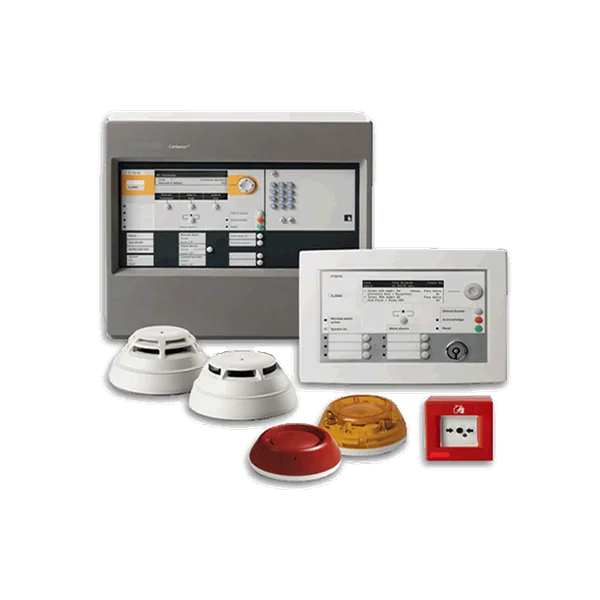
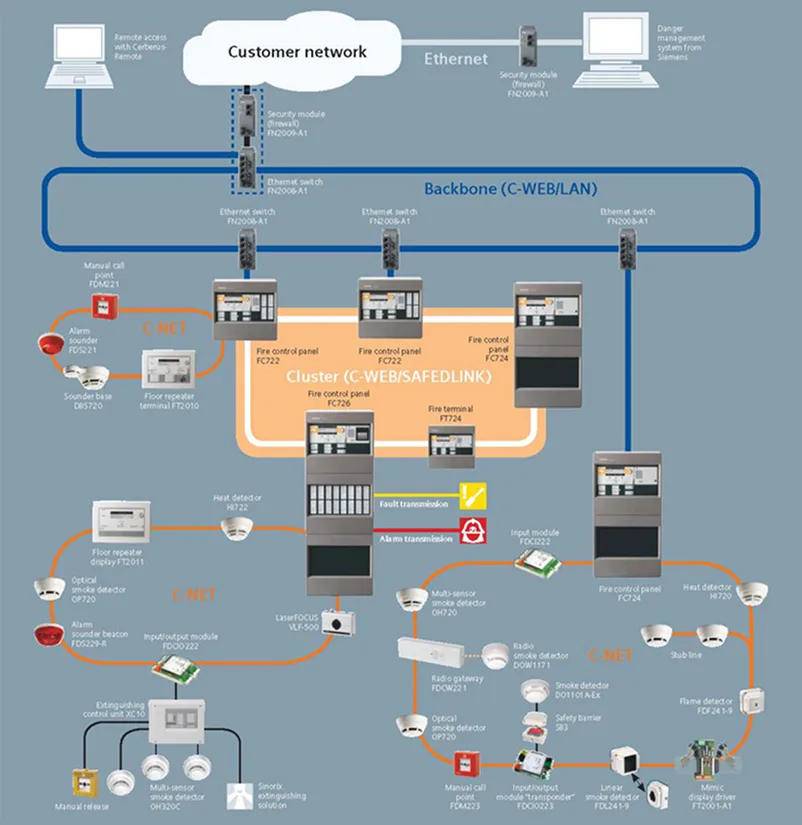
The fire system overview graphic also depicts how the fire system components can be connected with each other:
C-NET – detector bus network for linking fire detectors and peripherals
The C-NET is a modern, multipurpose detector bus system that allows flexible planning and installation: all detectors and peripheral devices share the same loop. The C-NET devices of the fire system communicate and get their power supply directly via the C-NET – without additional cabling.
Cluster (C-WEB/SAFEDLINK) – network for linking panels and fire terminals
Up to 16 fire control panels and/or operator terminals can be networked in one cluster (C-WEB/SAFEDLINK) – if the fire system is connected to a danger management station. Without a danger management station, even 32 panels can be networked in one cluster.
Backbone (C-WEB/LAN) – LAN network for linking clusters
Up to 14 clusters with up to 16 panels each can be networked via an EN 54-approved fiber-optic backbone (C-WEB/LAN). Due to the backbone, Cerberus PRO can even depict highly complex building structures and organizational processes. This makes the backbone the ideal solution when planning a large and complex fire system for universities, for example, with buildings spread over an extensive campus.